
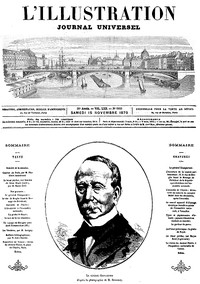
L'Illustration, No. 1603, 15 novembre 1873 by Various
Let's clear something up first: this isn't a book in the traditional sense. L'Illustration was a weekly French news magazine, famous for its detailed woodcut and steel engravings. This specific issue, from mid-November 1873, is a single slice of life from over 150 years ago. There's no single authorial voice or plotted storyline. Instead, the 'plot' is the collective consciousness of a society. You'll flip from reports on political speeches in the new Third Republic, to updates on scientific expeditions, to fashion plates, theater reviews, and advertisements for everything from pianos to patent medicines.
The Story
The 'story' is whatever was important enough to print that week. One page might show the solemn unveiling of a war memorial, heavy with recent loss. The next might be a bright, bustling scene of a new department store opening in Paris, signaling a return to normalcy and commerce. There are serialized fiction chapters, society gossip, and technical diagrams of new inventions. Reading it is an exercise in whiplash—in the best way. You're constantly shifting between tragedy and triviality, which feels incredibly honest. It's the messy, unfiltered narrative of a country picking up the pieces.
Why You Should Read It
I love this because it lets you be a historical tourist. You're not being told what 1873 was like; you're seeing what people in 1873 were telling themselves about their own time. The engravings are stunning works of art that make history feel tangible. You see the cut of a coat, the design of a carriage, the expression on a politician's face. It makes the past stop being a list of dates and start being a place you can visit. For me, the most powerful parts were the small, mundane details—the ads, the prices, the announcements—that no history book would ever bother with, but that truly define daily life.
Final Verdict
This is perfect for curious minds who find standard history books a bit dry. It's for the visual learner, the trivia collector, and anyone who enjoys getting lost in old newspapers or archives. If you like the idea of primary source detective work, where you connect the dots yourself, you'll be fascinated. It's not a breezy beach read, but a captivating, slow-burn immersion into another world. Keep a browser tab open for translation, pour a coffee, and prepare to time travel.
You are viewing a work that belongs to the global public domain. Share knowledge freely with the world.
Anthony Flores
1 year agoSurprisingly enough, the emotional weight of the story is balanced perfectly. Don't hesitate to start reading.
David Robinson
1 year agoIf you enjoy this genre, the arguments are well-supported by credible references. Truly inspiring.
Emma Flores
1 day agoWow.

Sarah Moore
3 weeks agoThis book was worth my time since it creates a vivid world that you simply do not want to leave. Thanks for sharing this review.