
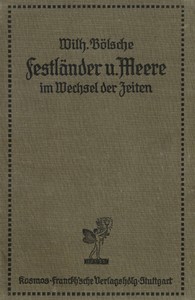
Festländer und Meere im Wechsel der Zeiten by Wilhelm Bölsche
Published in the early 1900s, Wilhelm Bölsche's book is a journey into the deep history of our planet. It's not a novel with characters, but the Earth itself is the protagonist. Bölsche gathers the scientific ideas of his time to explore a radical concept: that the arrangement of our continents and oceans is not permanent. He builds a case for a world in constant, slow-motion flux.
The Story
The 'plot' follows the evidence. Bölsche starts by pointing out the strange clues. Why do we find fossils of tropical plants in cold, northern regions? Why do the coastlines of continents like South America and Africa look like they could fit together? He walks the reader through the theories of his era, explaining how land might rise from the sea and how ancient oceans might have vanished, leaving behind only salt deposits and fossilized sea creatures in the middle of a continent. He paints a picture of epic, geological dramas—mountains buckling upward, vast inland seas drying out, and whole landscapes transforming over millions of years. The story he tells is one of discovery, of scientists trying to read the autobiography of the Earth written in stone.
Why You Should Read It
What makes this book special is Bölsche's voice. He was a master at making science exciting for everyday people. Reading this, you feel his genuine wonder. He isn't just listing facts; he's telling you a secret about the ground beneath your feet. It's fascinating to see which ideas from over a century ago we now know are correct (like continental drift, which was a fringe theory then) and which parts were the best guesses of the time. It gives you a real appreciation for how scientific understanding evolves. You get a sense of the bold imagination it took to even conceive that continents could move.
Final Verdict
This book is perfect for curious minds who love history, science, or just a good mystery about the natural world. It's for the reader who looks at a mountain range and wonders how it got there. While some of the science is dated, that's part of the charm—it's a snapshot of a thrilling moment in discovery. If you enjoy authors like Stephen Jay Gould or Bill Bryson, who make big ideas accessible and fun, you'll find a kindred spirit in Wilhelm Bölsche. Just be ready to see every cliff, valley, and coastline as a page in an unfinished story.
This publication is available for unrestricted use. Share knowledge freely with the world.
Carol Nguyen
1 year agoGood quality content.
Aiden Young
1 year agoNot bad at all.
Matthew White
5 months agoVery interesting perspective.





Deborah Lewis
8 months agoComprehensive and well-researched.