
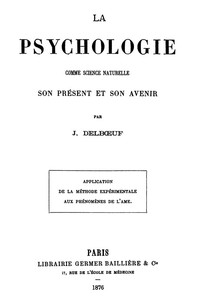
La psychologie comme science naturelle, son présent et son avenir by Delboeuf
Let's be clear: this isn't a novel. There's no plot in the traditional sense. But there is a story—the story of an idea fighting to be born.
The Story
In the late 1800s, psychology was having an identity crisis. Was it a branch of philosophy? A soft science? Joseph Delboeuf steps in with a radical proposal. He argues that for psychology to be taken seriously, it must become a natural science. This means it should use observation, experimentation, and measurement, just like biology or chemistry. He looks at things like sleep, dreams, and hypnosis not as mystical events, but as natural phenomena we can study. The whole book is his case for this new approach. He’s trying to drag the study of the mind out of the philosopher's armchair and into the laboratory.
Why You Should Read It
What grabbed me was Delboeuf's sheer ambition. He wasn't just tinkering at the edges; he wanted to rebuild the foundation. Reading him, you feel the excitement and the struggle of that moment in history. You see the early sketches of ideas that would later become huge parts of modern psychology. It's also humbling. Many of the debates he was having—about free will, consciousness, and the limits of science—are debates we're still having. His writing isn't always easy (it is from the 1870s, after all), but his passion for the subject is contagious. He makes you care about this big, abstract argument.
Final Verdict
This book is a hidden gem for a specific reader. It's perfect for psychology or philosophy students who want to see where their field came from. It's also great for anyone fascinated by the history of ideas. If you enjoy seeing how people in the past tackled the same big questions we face today, you'll find this incredibly rewarding. It's not a light beach read, but for the right person, it’s a thrilling trip into the mind of a pioneer who saw the future of his field long before anyone else.
This is a copyright-free edition. It is now common property for all to enjoy.
Aiden Walker
2 months agoFrom the very first page, the pacing is just right, keeping you engaged. Thanks for sharing this review.
Emily Allen
1 year agoVery interesting perspective.
Mason Garcia
1 year agoHonestly, the plot twists are genuinely surprising. I would gladly recommend this title.
Sandra Wilson
1 year agoFast paced, good book.


Christopher Garcia
7 months agoLoved it.