
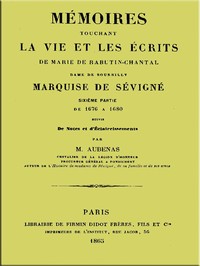
Mémoires touchant la vie et les écrits de Marie de Rabutin-Chantal, (6/6)
Let's be honest, the title sounds like a dusty academic paper. But don't let that fool you. Mémoires touchant la vie et les écrits de Marie de Rabutin-Chantal is actually a gripping historical detective story written in the 19th century. The author, Joseph-Adolphe Aubenas, wasn't just writing a biography; he was on a mission to recover a lost person from the shadows of a much more famous name.
The Story
This isn't a novel with a traditional plot. Instead, think of it as Aubenas showing you his work. He starts with a puzzle: Who was Marie de Rabutin-Chantal, beyond being the mother of the iconic letter-writer Madame de Sévigné? Using old legal documents, family papers, and contemporary accounts, he reconstructs her life. We learn about her privileged but complicated upbringing, her strategic marriage into the powerful Rabutin family, and her role as a young mother. The heart of the story, and its tragedy, is her sudden and violent death—she was killed in a crossfire during the political upheavals of the Fronde when her daughter was only seven. Aubenas traces how this event fundamentally shaped the famous woman his daughter would become, arguing that the loss haunted Sévigné's life and writing.
Why You Should Read It
What I love about this book is its sense of purpose. Aubenas writes with a real passion for justice—not legal justice, but historical justice. He's annoyed that this intelligent, connected woman has been reduced to a footnote. Reading it, you feel like you're looking over his shoulder as he connects the dots. It makes you think about all the other 'supporting characters' in history whose full stories we'll never know. It's also a sharp reminder that our understanding of famous figures is incomplete without knowing what formed them, especially the traumas of their childhood. The book is as much about the process of history as it is about the person.
Final Verdict
This is a niche read, but a rewarding one. It's perfect for history buffs who enjoy seeing how the sausage is made—how biographies are actually built from fragments. It's also great for fans of Madame de Sévigné who want to understand the profound sadness that often tinged her brilliant, lively letters. You need a little patience for the 19th-century prose and the deep dives into genealogy, but the payoff is a poignant, recovered portrait of a life cut short. It's a book that gives a name, a face, and a story back to someone history almost forgot.
This text is dedicated to the public domain. Preserving history for future generations.
Richard Wilson
2 months agoHigh quality edition, very readable.
Amanda Lopez
1 year agoHaving read this twice, the storytelling feels authentic and emotionally grounded. A true masterpiece.
Kenneth Brown
1 year agoHigh quality edition, very readable.
Aiden Thomas
1 year agoI have to admit, the arguments are well-supported by credible references. I learned so much from this.




Robert Robinson
4 months agoFast paced, good book.