
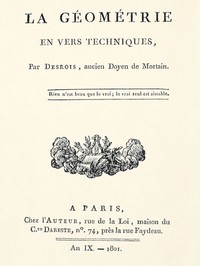
La géométrie en vers techniques by Lyon Des Roys
Let's get this straight from the start: this book is not a story. You won't find heroes, villains, or a twisting plot. 'La géométrie en vers techniques' is exactly what the title promises—a geometry textbook written in poetic verse. Published in the 1700s by Lyon Des Roys, it represents a fascinating, almost forgotten experiment in education. The author believed that by casting mathematical principles into rhyme and meter, students could memorize and understand them more easily. The 'plot' is simply the journey from one geometric concept to the next, each framed not with dry diagrams and proofs alone, but with structured poetry.
The Story
There is no narrative in the traditional sense. Instead, the book systematically walks through geometric fundamentals. Think of it as a guided tour where your guide insists on speaking in iambic pentameter. One stanza might define a line segment, the next might explore the properties of a triangle, and a later canto could be dedicated to the intricacies of conic sections. The 'action' is all mental, following the logical progression of ideas, but dressed in the formal wear of French classical verse. It's the relentless, charming persistence of applying one form of discipline (poetry) to explain another (mathematics).
Why You Should Read It
I love this book because it's a personality captured in print. You can feel Lyon Des Roys's earnest conviction on every page. He wasn't just writing a textbook; he was making an argument for beauty in logic and structure in art. Reading it, you bounce between moments of genuine cleverness—where a rhyme actually clarifies a concept—and patches of glorious, awkward struggle where the math and the meter are clearly at war. It’s human and quirky. It makes you think about how we learn and how we try to connect different parts of our brain. The book itself becomes a proof of a different kind: that passion and a unique perspective can turn even the driest subject into something strangely captivating.
Final Verdict
This is a niche gem, but a brilliant one. It's perfect for history buffs curious about Enlightenment-era thinking, poets interested in unconventional forms, math teachers looking for a curious anecdote, or anyone who collects wonderfully odd books. It's not a page-turner, but it's a mind-expander. You won't race through it, but you'll smile, scratch your head, and come away with a fantastic story about the time someone tried to teach geometry with a sonnet. Approach it like a museum exhibit—a small, glass-case look at a wildly creative idea—and you'll be delighted.
The copyright for this book has expired, making it public property. You do not need permission to reproduce this work.
Daniel Miller
1 year agoSurprisingly enough, the pacing is just right, keeping you engaged. One of the best books I've read this year.
Daniel White
1 year agoI have to admit, the flow of the text seems very fluid. Thanks for sharing this review.
Jackson Moore
1 year agoA must-have for anyone studying this subject.