
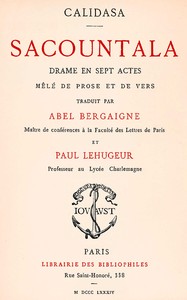
Sacountala, drame en sept actes, mêlé de prose et de vers by Kālidāsa
Let's talk about one of the oldest love stories that still feels fresh. 'Śakuntalā' is a play from the 4th or 5th century by the Sanskrit poet Kālidāsa, and it's a whirlwind of romance, magic, and human error.
The Story
King Duṣyanta, on a hunting trip, stumbles into a peaceful forest hermitage and is instantly captivated by Śakuntalā, a woman of stunning beauty and grace who was raised there by a sage. Their connection is immediate and deep, leading to a secret, passionate marriage. When the king has to return to his court, he gives Śakuntalā his signet ring as a promise to send for her.
But here's where it gets complicated. A short-tempered sage, angry that Śakuntalā is distracted by love, curses her: the person she's thinking of will forget her. There's a loophole—a token, like a ring, can break the curse. She sets out for the court, but on the journey, the ring slips from her finger into a river. When she arrives, the curse is in full effect. The king has no memory of her or their marriage. Humiliated and heartbroken, Śakuntalā is taken away by a celestial being. Later, a fisherman finds the ring in a fish's belly. The king sees it, his memory floods back, and he's consumed by grief and regret. The final act is a divine reunion, proving that true love, even when lost, can be found again.
Why You Should Read It
What grabbed me wasn't just the plot, but how real the emotions feel. Duṣyanta isn't a villain; he's a victim of magic, and his anguish when he remembers is palpable. Śakuntalā's strength in her despair is moving. The play also beautifully contrasts worlds: the pure, natural forest versus the rigid, formal court. It asks big questions about how we remember love and the tiny, fragile things (like a ring) that hold our most important truths. Kālidāsa's writing—even in translation—is full of gorgeous descriptions of nature and raw feeling.
Final Verdict
This is a perfect pick for romantics who enjoy myth and magic, or for anyone curious about classic world literature that's accessible and emotionally powerful. It's not a difficult history lesson; it's a timeless story about a forgotten promise and the long journey to make things right. If you've ever loved stories where fate gives love a second chance, you'll adore 'Śakuntalā.'
Legal analysis indicates this work is in the public domain. It is now common property for all to enjoy.
Brian Williams
1 year agoThanks for the recommendation.
George Smith
1 year agoHaving read this twice, the plot twists are genuinely surprising. Worth every second.
Noah Torres
3 weeks agoAfter finishing this book, the flow of the text seems very fluid. I will read more from this author.
Elizabeth Hill
5 months agoJust what I was looking for.








John Lopez
1 year agoHonestly, the depth of research presented here is truly commendable. Don't hesitate to start reading.