
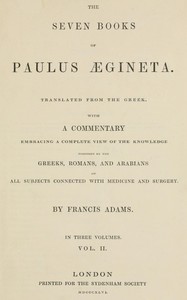
The seven books of Paulus Ægineta, volume 2 (of 3) : translated from the…
Let's be clear from the start: this isn't a novel. There's no protagonist chasing a villain. The 'story' is the story of medicine itself, as understood by one of the last great physicians of the ancient world. Paul of Aegina compiled everything he knew from Greek, Roman, and earlier Byzantine sources into a seven-book masterwork. Volume 2 dives deep into the practical stuff. We move from general theories into the nitty-gritty of specific diseases and their treatments.
The Story
Think of it as a massive, systematic FAQ for a 7th-century doctor. The book is organized by affliction. It starts with conditions of the head (fevers, headaches, 'phrenitis' which might be meningitis or delirium) and works its way down the body. For each ailment, Paul describes the symptoms, gives his theory on what causes it (often an imbalance of blood, phlegm, yellow bile, or black bile), and then lists treatments. These range from gentle herbal infusions and dietary advice to complex surgical procedures for hernias, bladder stones, or eye cataracts. The 'narrative' is the logical progression of a healer's mind, methodically addressing the human body from top to bottom.
Why You Should Read It
This book is a time machine. It completely reshapes how you see history. You don't just read about the Byzantine Empire; you see it through the eyes of someone tasked with keeping its people alive. The blend of keen observation (his descriptions of symptoms are often spot-on) with utterly foreign theory is fascinating. One paragraph he's correctly setting a broken arm with a splint, the next he's recommending a poultice of ground earthworms. It's humbling. It shows how brilliant, dedicated people built entire systems of care on incomplete knowledge. You develop a weird admiration for Paul—his compassion is evident, and his surgical techniques, given the era, are shockingly sophisticated.
Final Verdict
This is not a casual bedtime read. It's perfect for history buffs who want to go beyond kings and battles, for anyone in the medical field curious about the roots of their profession, or for readers who love primary sources that drop them directly into a different reality. If you've ever enjoyed a medical drama or wondered how people survived before antibiotics, this is the ultimate deep dive. Come for the historical curiosity, stay for the profound connection to a healer's mind across thirteen centuries.
This content is free to share and distribute. You are welcome to share this with anyone.
Donna King
1 year agoAs someone who reads a lot, the plot twists are genuinely surprising. Thanks for sharing this review.
David Perez
9 months agoI had low expectations initially, however the author's voice is distinct and makes complex topics easy to digest. One of the best books I've read this year.
Mark Walker
1 year agoI have to admit, the author's voice is distinct and makes complex topics easy to digest. Exactly what I needed.










Margaret Taylor
1 year agoAfter finishing this book, it challenges the reader's perspective in an intellectual way. I will read more from this author.